Your anodised aluminium printer still works. So when is it worth considering a replacement?

In short: The decision to replace an anodised aluminium printer rarely starts with a complete breakdown. Far more often it keeps running, but maintaining the required quality costs more and more time, operator effort and corrective work. The question that matters is what it costs today to get an accepted, repeatable product out of the machine and what risk keeping it running creates.
In industrial printing into anodised aluminium, the decision to change equipment rarely starts with a complete breakdown. Far more often the machine is still running production, but maintaining the required quality is starting to cost more and more time, operator effort and corrective work.
That distinction matters.
A machine that works technically is not necessarily an efficient production process.
That is why “Does the machine still work?” is not a sufficient question. From a production point of view, a far more important one is:
What does it cost today to get an accepted, repeatable product out of it, and what risk does keeping the system running create?
Only the answer to that question lets you judge rationally whether the current machine should remain your main line, or whether it is worth starting to analyse a replacement or a second, parallel production line.
A machine’s technical lifespan and a process’s economic lifespan are not the same thing
An industrial machine can run for many years, so age alone is not a sufficient reason to replace it.
The problem starts when the way it is used changes over time.
The operator knows more and more “workarounds”. They know which setting has to be corrected manually, how to handle a particular material, which parameter to change for a more difficult colour and what to do when the result starts to drift from what is expected.
To the organisation, this may look like experience and a well-understood technology.
Over time, however, some of this knowledge can become a hidden cost of keeping the process running.
If stable production depends on constant operator intervention, manual corrections and know-how that does not appear in the standard procedure, the company should start measuring not only the machine’s output, but also the effort needed to maintain that output.
First warning sign: more and more corrections to get the same result
When printing into the open pores of anodised aluminium, the final result does not depend on the printer alone.
It is influenced by, among other things, the material, the ink, the application parameters, the working conditions, file preparation and the subsequent sealing.
So a small instability in one element can force intervention in the next.
If the operator increasingly has to correct colour, change parameters, run extra tests or reprint a sheet, it is time to stop treating these actions as a natural part of the job and start measuring them.
For example, an extra 8 minutes spent preparing or correcting a single job may look insignificant. But if a plant runs 12 such jobs a day over 220 production days, that adds up to more than 350 hours of additional operator time a year.
And that does not yet include the cost of material, ink, reprints or machine time.
This is exactly how small daily losses start to build up the real TCO of an older system.
A repeat job should be genuinely repeatable
For manufacturers of nameplates, operator panels, scales and technical identification components, reproducibility is particularly important.
A customer may come back for the same product a month, six months or several years later.
In theory, it is a repeat job.
In practice, it is worth checking what the operator has to do to achieve an accepted result again.
Is it enough to open the saved job and the right material recipe?
Do the correct parameters have to be found all over again?
Is colour correction needed?
Does the result depend on which operator is at the machine?
Can older settings be safely reproduced after a change of material batch?
The more manual interpretation it takes to rerun a job, the more the process depends on people rather than on a controlled workflow.
This is not just about being able to save a file in the RIP. True repeatability means being able to reproduce the entire set of production conditions as predictably as possible.
The cost of a reprint is more than the cost of another sheet
A reprint is one of the costs that is easy to underestimate.
If a sheet is not accepted, you lose more than the aluminium.
On top of that come ink, machine time, operator time, additional inspection and repeating the subsequent process steps.
In printing into anodised aluminium, it is particularly important that product assessment does not end as soon as the sheet leaves the printer. Printing is part of a process that includes the subsequent sealing of the pores.
If a problem only shows up after sealing, its cost is even higher, because the plant has already carried out further operations.
That is why, when analysing your current line, it is worth measuring not only the number of reprints but also first-pass yield – the share of production that goes through the whole process correctly the first time.
It is a much better indicator of stability than a single, perfect-looking sample.
Downtime becomes a problem before the machine stops completely
Another warning sign is rising maintenance cost.
But you should not look only at the number of breakdowns.
The total time needed to get back to stable production tells you much more:
problem – identification – diagnostics – contacting service – fix – recalibration or set-up – production restart.
A machine may break down relatively rarely, but if every more difficult situation requires lengthy diagnostics or waiting for the right component, the risk to production is high.
This becomes especially important with older platforms, for which the availability of parts, updates or people with the right service knowledge is shrinking.
That is why, several years before the planned end of service life, it is worth asking about the availability of key components and whether the machine can continue to be supported.
A replacement carried out at a controlled moment is much safer than one forced by a breakdown.
How many points of responsibility does your current system have?
An industrial digital printer is not an isolated device.
The production result is shaped by the hardware, printhead control, firmware, RIP, ink, profiles, material and downstream process parameters.
If these elements come from several independent suppliers, a problem can bring one more cost: the time it takes to establish who is actually responsible for the diagnosis.
A colour reproduction problem may be blamed on the RIP. The RIP supplier may point to the ink or the profile. The material supplier may point to the process parameters.
Each of them may be partly right, because the result really is created where many elements meet.
From the customer’s point of view, though, one thing stays the same: production is still not running as planned.
That is why, when assessing a new system, it is worth analysing not only its specification but also its architecture of technological responsibility.
Who is responsible for integrating the machine and the software?
Who diagnoses faults?
Who develops the control system?
Who knows how the ink behaves in this particular process?
Who supports the operator after installation?
This is where the difference between buying a machine and choosing a technology partner begins.
Lack of redundancy can cost more than a second machine
If all production of a given type of marking depends on one printer, that machine becomes a single point of failure.
As long as it is working, the risk is practically invisible.
That is why it is worth running through a simple scenario:
What happens if the printer stops tomorrow for two days?
Is there a second line?
Can jobs be moved to another machine?
Will outsourcing be necessary?
How quickly can an external supplier take over production?
What about delivery deadlines?
Will the subsequent production stages also come to a standstill?
What will express logistics and overtime cost once work resumes?
Only the sum of these consequences shows the value of redundancy.
Importantly, building a backup does not always mean replacing the existing machine straight away.
In some plants, a much safer solution may be to bring in the new machine as a second line and transfer production gradually.
The old system continues to run the well-established jobs. The new one takes over part of the volume, the more demanding orders or production that needs greater flexibility.
The company increases capacity and reduces risk at the same time.
Operator cost deserves the same attention as ink cost
When a technology is analysed, a lot of attention goes to the cost of consumables.
They are easy to calculate.
Operator time is costed in detail far less often.
Yet it is worth calculating all the time associated with a single job: from preparing and setting up the material, through tests and corrections, to cleaning, job changeover and getting production back after an error.
If running the system requires a lot of experience and a series of undocumented steps, the company is not only paying for working hours.
There is also a key-person risk.
What happens if your most experienced operator leaves or is absent?
Can another employee achieve the same result?
Has the knowledge been captured in the process?
A modern production platform should aim to reduce dependence on manual corrections. Not because the operator’s knowledge is unimportant, but because their skills should be used to control the process, not to constantly compensate for its shortcomings.
The purchase price is only the first line of the calculation
A machine replacement should not be justified by the new platform being “more modern”.
You need a business case.
A sound comparison should include at least the cost of purchase and financing, ink and consumables, parts, service, operator time, waste, reprints, downtime, and software and workflow maintenance.
Only that kind of calculation lets you compare the five-year TCO of the old and the new platform.
At this point it may turn out that continuing to use a fully depreciated machine is still the best option.
But the opposite may also turn out to be true: a machine whose CAPEX was settled long ago is generating high operating costs and risks that do not show up in its book value.
So “our current machine is already paid off” should not end the analysis.
It should start it.
Not every working machine needs replacing
The other side of this decision matters too.
If the current machine:
- reproduces jobs consistently,
- does not cause significant downtime,
- has service and parts available,
- does not require excessive operator intervention,
- has sufficient capacity,
- matches your current production mix,
then replacing it immediately may not be economically justified.
In that case, a better investment may be to optimise the process, create redundancy or add a second system for a different type of work.
The goal is not to own the newest machine.
The goal is the most predictable and economically justified process.
How to check whether replacing your anodised aluminium printer really makes sense
Don’t start by comparing catalogues.
The most reliable starting point is a benchmark under conditions that reflect your real production.
The same material.
The same file.
The same sealing procedure.
The same acceptance criteria.
Choose a job that contains the elements that are genuinely difficult: critical colours, neutral greys, gradients, fine text, thin lines, QR codes, barcodes or serial data.
Then measure not just how the sample looks, but also preparation time, print time, the number of operator actions, the number of test runs, waste and whether the same result can be reproduced again.
Only then can you move on to the TCO calculation.
IMAGO as a process partner, not just a machine supplier
At IMAGO, we treat printing into anodised aluminium as a complete process: from the material and job preparation, through controlled ink application, to sealing, installation and ongoing technology support.
That is why a conversation about modernisation should not automatically start with an offer for a new machine.
First, you need to understand the existing production.
Which jobs cause the most problems?
Where do corrections occur?
How long does it take to rerun an older project?
What does service look like?
Does the company have redundancy?
What does a day of downtime cost?
Which parts of the process depend on a specific operator?
Only once this data has been collected can you check whether a new platform really reduces cost and risk.
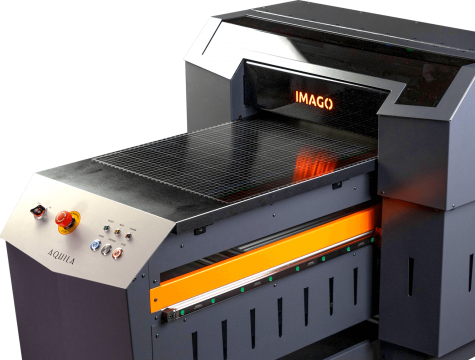
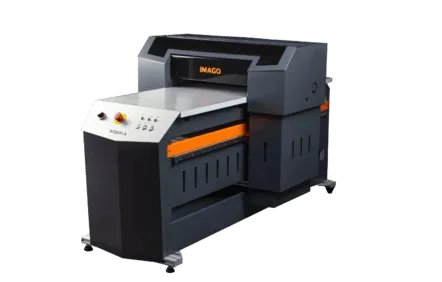
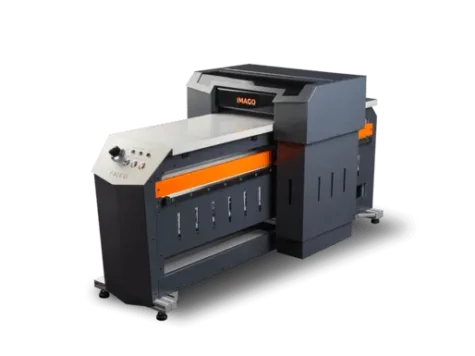
IMAGO designed the NF Series as part of a complete workflow for printing into anodised aluminium, covering not only the machine itself but also dedicated inks, software, material, a process bath, installation and process support.
That does not mean every working printer should be replaced.
It means something more practical:
before your current system becomes a critical production constraint, it is worth knowing what keeping it running really costs and which modernisation scenarios are available.
The machine may still work. The question is whether it still works for the business
The best time to analyse a replacement is not when the machine has stopped working completely.
By then, the decision has already been forced.
It is much better to start earlier – when you can calmly collect data, run a benchmark, reproduce key jobs and, if needed, start up the new platform in parallel.
That is why, with an older system for printing into anodised aluminium, it is worth regularly asking one question:
Is the current machine still the most predictable, safe and economically justified way to run this production?
If the answer is no longer obvious, that does not yet mean the machine has to be replaced.
It means it is time to start measuring.
And to base the modernisation decision on data from your own process, not on the age of the machine or the manufacturer’s claims.
FAQ: replacing an anodised aluminium printer
When should you replace an anodised aluminium printer that still works?
It is worth starting to analyse a replacement when the cost of keeping a predictable process running starts to rise: more corrections, more operator intervention, more reprints, longer recovery after faults and growing risk. Rising cost does not automatically mean the machine has to be replaced – it means it is time to start measuring. Age alone is not a reason. What matters is what it costs today to get an accepted, repeatable product out of the machine and what risk continued operation creates.
What are the warning signs that an older printer has become a hidden cost?
Typical signs are more and more corrections needed to get the same result, repeat jobs that require the parameters to be found again, reprints and problems that only appear after sealing, longer recovery to stable production after a fault, shrinking availability of parts and service know-how, and a process that depends on one experienced operator.
What is first-pass yield and why does it matter in anodised aluminium printing?
First-pass yield is the share of production that goes through the whole process, including sealing, correctly the first time. It is a much better indicator of stability than a single, perfect-looking sample. It also matters because a rejected sheet costs not only aluminium but also ink, machine and operator time, inspection and repeated process steps.
How much operator time can small corrections cost?
More than it seems. An extra 8 minutes of preparation or correction per job, at 12 jobs a day over 220 production days, adds up to more than 350 hours of additional operator time a year. That figure does not yet include the cost of material, ink, reprints or machine time.
Is it always better to replace an old printer?
No. If the current machine reproduces jobs consistently, does not cause significant downtime, has service and parts available, does not need excessive operator intervention, has sufficient capacity and matches the current production mix, immediate replacement may not be justified. Optimising the process, creating redundancy or adding a second system may be a better investment.
How can you test whether a new printer is worth it?
Run a benchmark under conditions that reflect real production: the same material, file, sealing procedure and acceptance criteria. Choose a genuinely difficult job and measure preparation time, print time, operator actions, test runs, waste and whether the result can be reproduced again. Only then move on to the TCO calculation.