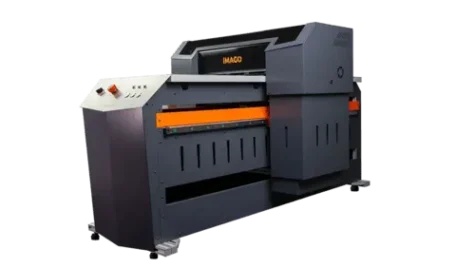
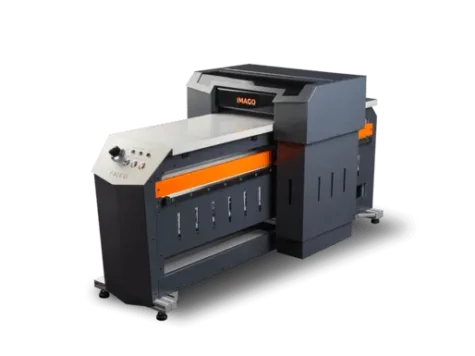
We designed and built the US-162: the new IMAGO single pass. What sets it apart and where to see it

Author's post
Weronika Pęsiek
Date of addition
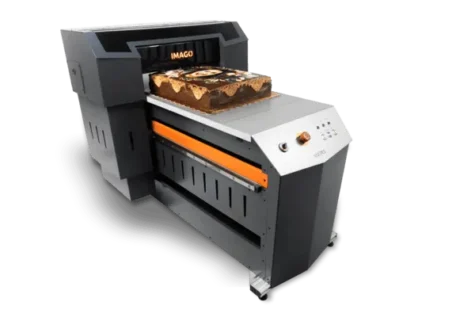
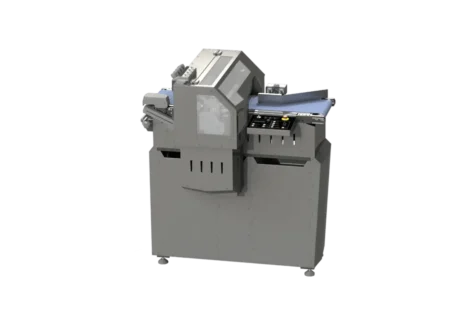
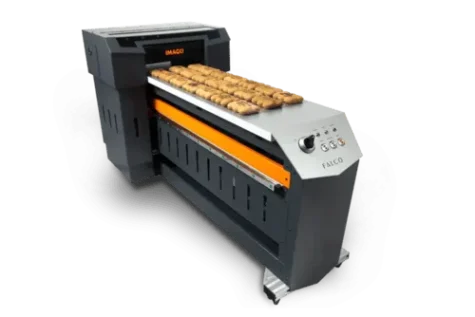
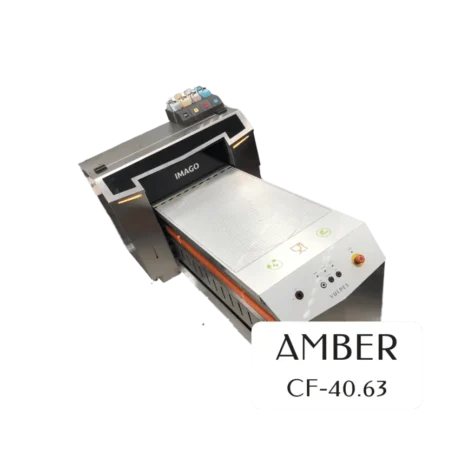
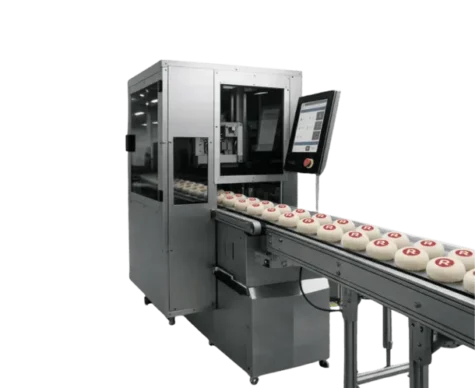
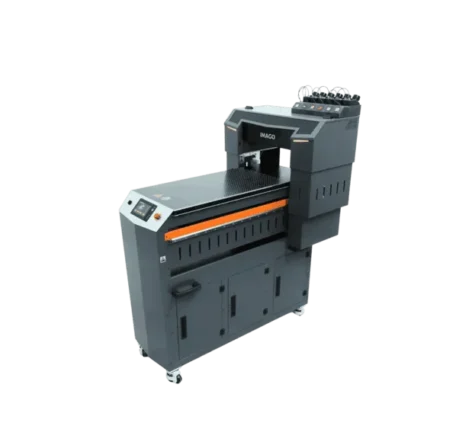
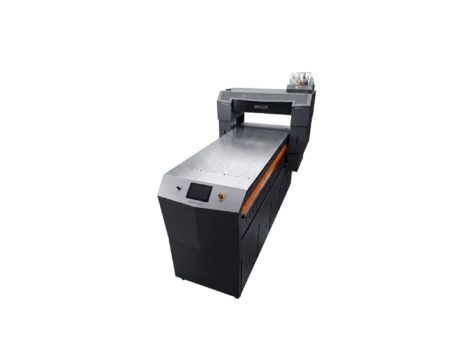
We designed it. We built it. Now we are bringing a new IMAGO Single Pass solution to market: the US-162. It is the work of our Polish R&D team – an industrial digital UV printing system designed with one goal in mind: to bring high-quality digital printing into the production process without complicating the whole plant.
We did not want to build yet another large machine that forces the customer to adapt the hall, the infrastructure and the way they produce. We did the opposite. The system is meant to fit the customer’s product and process – lids, covers, cosmetic cases, housings and enclosures that are made in series and in many versions.
The US-162 is installed at our headquarters in Warsaw. You are welcome to come for a demo and test printing on your own parts – details at the end of the article. First, what we did differently with this machine and why.

What sets the IMAGO approach apart
There are many systems for digital printing on products. The difference does not lie in the print head or the ink itself, but in how much a plant has to change to get such a system running, and how much its day-to-day operation costs afterwards. Here are eight things we focus on when designing the US Series.
1. Compact design for industrial work
The US-162 automates and speeds up decoration or marking, but it does not take up a whole wall or a large part of the hall. The standalone unit on castors can be placed in the main production flow, in a separate room, in previously unused space or in a small area dedicated to decoration. The plant increases automation without rebuilding the hall.
2. Simpler infrastructure
The machine does not need the connections typical of many industrial machines: three-phase power, a compressed air supply, a water connection or any additional process infrastructure. It runs on single-phase 230 V. As a result, implementation means far fewer organisational and technical changes on the customer’s side.
3. Standard installation in one working day
Start-up does not take weeks, as it does with many large industrial systems. A standard installation fits into one working day and includes operator training. Shorter downtime, fewer people involved in commissioning, less risk of disrupting production.
4. One process owner on the customer’s side
Preparing the implementation does not require many departments. One person responsible for the process is enough – together we agree on where the machine will stand, how products will be fed, the print parameters, the training plan and how work will be organised. The customer does not have to involve “half the company” to implement a new technology.
5. Operation designed for the production floor
The machine is operated by a production worker with no specialist printing experience. Their tasks are referencing, preparing the machine and starting the print; operator training on the shop floor takes about 30 minutes, after which they work from a workstation instruction. There is no need to hire a skilled printer. For plants that want more independence, we also run extended technical operator training and maintenance staff training – after which most basic service tasks are carried out on site.
6. Digital flexibility
Changing a job is mainly a matter of changing the file. There is no need to prepare stamps, moulds, screens, dies or tooling for a single design. Changeover is quick and does not generate the costs typical of analogue technologies, so the same machine handles short runs, personalisation, language versions, changing designs and long runs of a single design.
7. Full colour in single pass technology
Single pass is often associated with simple marking: codes, one colour, basic labelling. The US-162 prints in full CMYK colour with a white underprint – graphics, photos and fine text – in a quality previously associated with scanning machines. This combination of in-line throughput and print quality is the core of the project.
8. A system built around the product
We match the way parts are fed, guided and positioned to real production conditions: feeders, modules sized for a specific part, guiding elements and, for non-standard products, custom solutions. We define the configuration after a site visit and process analysis, in a conversation between an IMAGO advisor and the person responsible for production. Throughput is matched to the pace of the process – printing should work at the rhythm of production, not become its bottleneck.
What we built at IMAGO: US-162 specifications
The US-162 belongs to the US Series – standalone units for in-line digital product decoration. Key specifications:
- 10 × Epson I3200 print heads
- print width up to 162 mm
- product height up to 100 mm
- resolution 4200 × 600 dpi
- CMYK + white (other colour configurations are agreed with the customer for the specific application)
- ink recirculation in all channels
- pinning + final UV curing in the pass
- proprietary IMAGO control software
- single-phase 230 V power, no compressed air or water; unit on castors
Two solutions help with white: ink recirculation in all channels and additional mixing of the white ink, which helps limit pigment settling. Opacity, number of layers and the position of white relative to colour are defined for the specific design and material. A capping station protects the heads from drying out during downtime. The pinning lamp stabilises the droplet immediately after it is jetted, and the final lamp cures the finished print. Control is handled by proprietary IMAGO software, so changing a job means changing the file.
Together with the feeder, the unit needs at least 5.61 × 3.12 m of floor space (including 0.8 m access on each side), plus space for the operator station and collection of finished parts. The electrical circuit and protection are selected according to the documentation, as for any 6 kW machine.
How in-line printing works
The heads stay in place. The aligned product passes under the print zone once. The graphic is a file, so the next version is another file instead of another screen, film or label. On dark or transparent plastic, white is laid under the colour in the same pass, so a photo on a black case does not need a second operation.
To be honest: set-up, cleaning and first-article inspection are still there. What disappears is the tooling for each design – and with it, waiting for tooling and stock of variants in the warehouse. Graphics are changed between jobs; we do not promise different graphics within a single cycle without confirming the configuration.
The product must have a stable, flat print area. 100 mm is the maximum part height, not a promise of printing on a vertical wall or all around the object. The way the part is guided (holder, guides, positioning) is defined for the specific application.
Which parts the US-162 makes sense for
The same family of lids, three brands, five markets and two seasonal collections: a rack of labels in the warehouse, a screen for every version in prepress, and waiting for new tooling whenever the graphics change. Production managers know this calculation: you pay for the machine once, but you pay for every change every month. Add dark or transparent plastic on which marketing wants a photo and a gradient, while in the current process every colour means a separate screen and a separate pass.
The directions below are based on the US-162 product sheet and its limitations. None of them is a list of “guaranteed” applications: we qualify every part in a test, because material, geometry and resistance requirements differ even within a single family.
LIDS AND CAPS: closures for jars, buckets and containers which, with the same geometry, serve many brands, markets and languages. The value here is replacing a rack of labels with files, and fewer mistakes when picking a label.
COMPACT BOXES AND COSMETIC CASES: dark or transparent beauty packaging that gets a new collection every quarter. White underprint under full colour gives a photo and a gradient without a label and without a mould for each collection. Resistance to cosmetics and abrasion is checked on a sample.
TECHNICAL HOUSINGS AND ENCLOSURES: electronics housings and cases in OEM and language versions. Pictograms, markings and fine text from a file, on the same blank, for five markets. Marking durability is confirmed by abrasion and chemical tests on the customer’s material.
NOTEBOOKS AND FLAT SURFACES OF LOW BOXES: series products with stable geometry, where short runs and personalisation do not pay off in prepress today. This is a direction we are still confirming with our own tests, which is exactly why we invite you to bring such parts.
PRODUCT PARTS THAT CARRY A LABEL TODAY: wherever a marking peels off in use or requires a separate operation, and the product needs full colour and white – provided there is a stable, flat print area and the part is up to 100 mm high.
More broadly, plants use the US Series for permanent marking, printing barcodes and 2D codes, product information and ingredient lists, labels printed directly on the part, and for decorating packaging and product components. For food and pharmaceutical packaging, UV printing applies to packaging and components that do not come into contact with the product; direct contact requires separate inks and certification.
What it changes in the production calculation
The value of digital decoration does not come from run length alone, but from the number of changes. A family with forty versions pays for moulds, start-ups and rejects forty times; a family with one version pays once. That is why we start every conversation about the US-162 by asking how many versions pass through the same geometry in a quarter. We match the system’s throughput to the actual pace of production and confirm it on the part, because conveyor speed is not the same as the number of accepted parts per hour.
We calculate the business case for the entire SKU family and the whole process, not just the price of the machine: the cost of a single print and of the whole run, the cost of energy (calculated on the customer’s data), reduced manual work, changeover costs, stock of labels and blanks, rejects, outsourcing – and the potential growth in the number of products made. Three scenarios (conservative, base, strategic) on the customer’s data.
The backing behind the machine
The design, electronics, software and assembly of the US-162 are done in Warsaw, which shortens the path from a technical question to an answer. Two laboratories stand behind process selection: Proof Lab in Warsaw, which since 2023 has carried out around 100 tests on around 60 materials and selects print parameters, colour profiles, primers and surface activation methods, and INKnovation Lab in Lublin, responsible for inks, primers and top coatings. IMAGO has more than 700 installations in over 65 countries. Engineered & Made in Poland.
See the US-162 in Warsaw: what a demo looks like
A US-162 unit is installed at the IMAGO Printer headquarters in Warsaw (ul. Zawodzie 7c). We invite you to live demos with test printing on the parts you bring.
What it looks like:
- You send a photo of the part with dimensions and book a date (info@imagoprinter.com, +48 695 234 513). Parts that can be guided on the standard belt are printed straight away; unusual shapes are qualified before the visit.
- You bring about 30 pieces of the part (some will be destroyed during testing) and a graphic file; if you do not have one, we will use our test graphic.
- We print on your parts, with you present.
- Together we check: white opacity on your material, colour registration relative to the base layer, legibility of fine text, how the part is guided through the print zone and whether the print area fits within 162 mm for a part up to 100 mm high.
- You leave with samples for your own abrasion, chemical and ageing tests, plus an initial assessment of part guiding and white opacity. Adhesion and resistance are confirmed by testing, not by a demo.
If the goal is to select a machine, the test is free of charge. If a visit to Warsaw is not an option, we run the test at Proof Lab on samples you send – you get back the printed samples and a test report.
One sentence on line integration
The US-162 can work as a standalone unit with its own belt next to the line, or be incorporated into an existing production process. If the process requires full line integration, a different transport system or several lanes, this design opens the way to Custom Single Pass solutions with a print width of up to 162 mm and product height of up to 100 mm.
Questions worth asking every single pass supplier
These questions separate claims from evidence. Ask them to us and to every other manufacturer:
- Does it print on this product? Evidence: a sample from a real batch, with the substrate, preparation and graphics identified.
- What is the real throughput? Evidence: good parts per hour, stating lanes, layers, spacing, handling and rejects. Our answer to this question is a test on your part, not a number from a table.
- How is a job changed? Evidence: the time from the last good part A to the first accepted part B, separately for a graphics change and a geometry change.
- What does the price include? Machine, software, feeding, holders, surface activation, inspection, installation, training, service.
- What does day-to-day operation involve? Daily tasks, downtime, restart, consumption of fluids and parts, availability of support.
- What does the declared quality mean? Reference standard, registration and colour criteria, fine text, adhesion and in-use resistance.
A fair comparison of offers means one product, two designs and shared acceptance criteria. Bring two files – we will check both at the demo.
Frequently asked questions
Is the US-162 suitable for my part? If the part has a stable, flat print area, the print area fits within 162 mm, the part is up to 100 mm high and it is produced in series in many versions, it is a candidate. A test on your parts decides.
Does white cover on black and transparent plastic? White opacity, the number of layers and colour position are defined for the specific design and material. This is exactly what we check at the demo.
Is the print durable? We confirm adhesion and resistance with tests on the customer’s material: tape, abrasion, chemicals, ageing. For difficult plastics such as PP and PE, Proof Lab selects surface activation as a separate process step. We do not declare resistance without a test.
How many parts per hour does the machine produce? Throughput depends on part size, spacing, number of rows, feeding method and required quality, which is why we do not give a single figure. We match it to the pace of your production and confirm it on the part.
How long does implementation take and who operates the machine? A standard installation fits into one working day and includes operator training (about 30 minutes). The machine is operated by a production worker with no specialist printing experience; one process owner on the customer’s side is enough.
Can I test my part without visiting Warsaw? Yes. You send about 30 pieces and a graphic file to Proof Lab; you get back printed samples and a test report.