Why Implement Digital Printing? Replacing Labels and Pad Printing: An Industrial Perspective

Digital printing has revolutionized the way industrial products are marked, offering unprecedented flexibility, speed, and customization. As businesses seek to streamline operations and respond to rapidly changing market demands, understanding why implement digital printing is crucial. In this analysis, all aspects, advantages, and disadvantages of digital printing are covered to provide a comprehensive overview for decision-makers.
In recent years, digital printing technology has seen significant advancements, particularly in image resolution and color accuracy, making it an increasingly attractive alternative to traditional methods. These improvements have contributed to digital printing’s growing market share and its viability for a wide range of applications.
Modern digital presses provide sharp, vibrant, and consistent results that can rival traditional offset quality, ensuring that businesses do not have to compromise on print standards when choosing digital solutions.
Additionally, digital printing is generally more cost-effective than offset printing for smaller quantity ranges, as it allows for printing only what is needed without the setup costs associated with traditional methods. This makes it an ideal choice for businesses looking to minimize waste and optimize their marketing budgets.
Introduction: A Shift in Industrial Product Marking
Industrial product marking and decoration is going through a fundamental shift. Traditional methods—labeling and pad printing—that served as the production standard for decades are becoming a constraint in the printing industry, especially in the Industry 4.0 era. Among these, the offset printing process is a traditional method that uses etched plates to efficiently print large volumes, offering advantages in color accuracy, metallic inks, and material variety, making it ideal for high-volume, professional-quality jobs. Growing consumer demand for personalization, pressure to shorten time-to-market, and the need to reduce operating costs are pushing manufacturers toward more flexible solutions.
Digital printing, especially advanced technologies like industrial Single Pass UV flow printing systems, answers these challenges. This isn’t just a technology upgrade. It’s a strategic move toward agile manufacturing, where flexibility, predictability and integration with digital management systems define competitiveness. Digital printing also lets you start production the moment files arrive, which dramatically shortens lead times.
This article presents a complete analysis of the economic, operational and strategic benefits of replacing labeling and pad printing with industrial digital print. The analysis draws on real implementation data and comparative studies, and it’s directed at production managers, COOs and business owners looking for measurable savings and process optimization. Notably, digital printing accounted for 16.2% of global print market value in 2017, highlighting its growing role and popularity in the printing industry as an alternative to traditional methods.
Digital print works for companies across many industries thanks to its broad applications and the ability to handle short runs. As a versatile solution, digital printing adapts to a wide range of applications and substrates, making it suitable for diverse production needs. The biggest advantages of this technology come from leaving traditional methods like offset behind in favor of modern techniques, which translates into high-quality digital output across diverse use cases. Digital print also makes content updates simple, which matters whenever materials need refreshing or correcting. Digital printing offers significant strategic advantages, including enhanced business agility, cost-efficiency, and greater marketing impact.
The Hidden Costs of Traditional Methods: What You’re Really Paying for Labeling and Pad Printing
Setup Costs and Production Line Downtime
One of the most painful costs (and one routinely missed in simple calculations) is preparation and changeover. With pad printing, every design change requires:
- Physical replacement of the cliché (matrix). One cliché typically costs 200-500 PLN, and multi-color print needs a separate cliché per color
- Creating a new cliché often involves producing a film (such as a film-positive or line screen film) and using a UV exposure unit as part of the photopolymer plate-making process
- Cleaning the ink cup and possibly replacing the pad
- Recalibrating the machine and running quality tests
Traditional methods need long setup times before production can run, which hits efficiency and stretches downtime.
Changeover takes 30-60 minutes on average. With production line operating costs of 500-1500 PLN/hour, that’s 250-1500 PLN of direct loss per changeover. The first units after changeover are often startup waste, pushing the total cost higher.
In production environments aiming at SMED (Single-Minute Exchange of Die), where changeover targets sit below 10 minutes, downtime like this is unacceptable and directly drags down OEE (Overall Equipment Effectiveness).
Labeling has faster changeovers (swapping label rolls and thermal transfer ribbons), but it becomes a problem under High-Mix/Low-Volume production. With 10-15 SKU changes per day, accumulated short stoppages can strip 1-2 hours of effective line time daily. Annually, that means 150,000-450,000 PLN in losses (assuming 250 working days and a downtime cost of 600-900 PLN/hour).
Inventory Storage: Capital You Can’t Touch and Obsolescence Risk
Labeling carries hidden costs tied to logistics and warehousing. Companies have to:
- Order minimum label quantities (MOQs often 1,000-5,000 units per variant)
- Warehouse stock for every active SKU
- Manage obsolescence risk when branding, formulations or regulations change
Storage cost can be estimated as:
Storage cost = (Inventory value × Cost of capital) + Warehouse space cost + Value loss risk
Example: A company with 50 product variants, holding an average of 3,000 labels per variant at 0.15 PLN each:
- Frozen capital: 50 × 3,000 × 0.15 PLN = 22,500 PLN
- Cost of capital (8% annually): 1,800 PLN/year
- Warehouse space cost (5 m² × 150 PLN/m²/month): 9,000 PLN/year
- Disposal risk from changes (5% annually): 1,125 PLN/year
- TOTAL: 11,925 PLN/year on label storage alone
Limited print-on-demand capability also makes production harder to optimize. It leads to excess inventory, increases obsolescence risk, and pushes warehousing costs higher.
Print errors at an external print shop or transit damage can wipe out entire batches and delay production. Lead time for new label orders typically runs 5-14 days, which is real operational risk.
In pad printing, the need to warehouse clichés for every active design also generates costs, and the clichés themselves are vulnerable to mechanical damage and technological obsolescence.
Waste Generation and Rising Environmental Compliance Costs
The environmental angle is becoming a heavier cost factor as EU regulations tighten under the European Green Deal.
Labeling generates significant waste by design:
- Silicone backing (liner waste) – hard and expensive to recycle
- Used thermal transfer ribbons – requiring specialized disposal
Estimated waste volume (liner waste): with a 10 cm² label, where the backing makes up roughly 40% of the material surface, every 10,000 labeled products generates about 40,000 cm², or 4 m² of backing waste. At a million units annually, that’s around 400 m² of waste.
Pad printing creates more serious environmental challenges:
- VOC (Volatile Organic Compound) emissions from solvent-based inks
- Ventilation and filtration system investment (CAPEX: 50,000-200,000 PLN)
- High operating costs for air treatment systems (energy, filter maintenance)
- Hazardous waste (paints, solvents, contaminated cleaning materials) requiring specialized disposal
In contrast, digital printing often uses water based inks, which are more eco-friendly and VOC-free compared to traditional solvent-based inks, further reducing environmental impact.
On top of that, regularly removing excess paint from matrices after each production cycle creates more waste and adds to the environmental cost of the pad printing process.
For an average pad printing facility, total emission and hazardous waste disposal costs can reach 20,000-80,000 PLN annually, depending on volume and ink type.
Personalization Limits: Lost Business Opportunities
The fundamental ceiling on analog methods is the lack of Variable Data Printing (VDP) without extra cost.
In pad printing, putting a unique serial number, QR code or personalized graphic on each product means making a new cliché for each unit, which is economically absurd. The lack of unique content and personalized output significantly limits marketing and business potential. This rules out a whole category of applications:
- Product serialization required in pharmaceuticals
- Mass personalization for marketing campaigns
- Track & trace through the supply chain
- Loyalty programs with unique codes
Labeling does allow variable data through thermal transfer printing, but it’s limited to simple, mostly monochromatic information (codes, dates). Full-color graphical personalization stays out of reach or becomes very expensive.
Digital printing enables companies to create unique, personalized products efficiently, opening new opportunities for innovation and customer engagement.
From a business perspective, missing personalization isn’t just a technical limitation. It’s lost revenue. Market research shows consumers will pay a 15-30% premium for personalized products, and companies offering this capability gain real competitive ground.
The Economics of Digital Print: Break-Even Point and TCO Model
Cost Structure: Fixed vs. Variable
Understanding digital print economics starts with comparing cost structures against analog methods. Every printing method (digital, pad printing, offset) has its own balance of fixed and variable costs. Digital print also makes content edits simple, so updates, corrections or audience-specific tweaks happen on the fly, which adds to its appeal.
Analog methods (pad printing and labeling):
- High fixed costs per run: cliché production, minimum label order volumes, time-consuming changeovers (especially in offset, where changes are costly and slow)
- Low variable costs: relatively cheap paint or label per unit
- Scale effect: unit cost drops sharply at very large, uniform volumes, making analog methods more economical for high-volume, long runs
Digital print:
- Near-zero fixed (preparation) costs: changing a design means loading a new file (2-5 minutes)
- Higher variable cost: ink cost per unit is usually higher than pad printing paint
- Scale effect: unit cost stays nearly flat regardless of run size
Break-Even Point
The clash between these two cost structures creates a break-even point that determines which technology is more profitable for a given production volume.
Comparative model (simplified example):
Take printing a logo on plastic packaging:
Pad printing:
- Cliché cost: 300 PLN (one-time)
- Changeover cost (time + waste): 400 PLN
- Paint cost per unit: 0.05 PLN
- Total cost = 700 PLN + (0.05 PLN × number of units)
Digital print:
- Preparation cost: 20 PLN (file loading time)
- Ink cost per unit: 0.15 PLN
- Total cost = 20 PLN + (0.15 PLN × number of units)
Break-even point: 700 + 0.05X = 20 + 0.15X → 680 = 0.10X → X = 6,800 units
For runs below 6,800 units, digital print is cheaper. Above that threshold, pad printing becomes more profitable, but only if production is uniform and doesn’t require personalization.
Offset printing, which uses printing plates and is the traditional choice for high-volume jobs, becomes the most cost-effective solution at very large volumes. Offset printing is typically more profitable than digital print when producing tens of thousands of units, due to its lower per-unit cost at scale and flexibility in ink and substrate options. Digital print, on the other hand, excels in short runs and personalized work, offering fast turnaround and high quality. Digital print can also produce single units, which makes it useful for debut products or test editions.
Market analyses confirm digital print is optimal for runs from 1 to roughly 500-1,000 copies. When you factor in storage costs and flexibility, the break-even point shifts to 5,000-10,000 units depending on product specifics.
Real Market Data: Operating Costs
Real numbers back up the low operating cost of digital print:
- Cost of printing the entire working table of a UV LED printer: about 0.25 € (manufacturer data)
- Cost per unit comparison in industrial marking: pad printing around 0.002 RMB/unit, digital/laser marking around 0.00048 RMB/unit, a 4x difference (industry analysis). At very high volumes, traditional methods like pad printing can still come out cheaper. Digital print wins at smaller runs.
- Digital printing also reduces the need for various supplies, such as plates and chemicals, compared to traditional methods, further lowering ongoing expenses.
- Energy use: UV-LED printers consume 40-60% less energy than traditional mercury UV systems and 20-30% less than pad printing systems with drying (comparative studies)
Operational Flexibility: How Digital Print Shortens Time-to-Market
Variable Data Printing (VDP): From Theory to Practice
Variable Data Printing is the most disruptive feature of digital print from a business standpoint. The technology lets you dynamically change part or all of the graphic for each individual unit in a production run, without stopping or slowing the line.
How it works in practice:
- The graphic template is designed in software like Adobe Illustrator or InDesign
- The file is exported to the printer’s RIP (Raster Image Processor) software
- The RIP merges the template with a database of variables (Excel, CSV, ERP/MES connection)
- The printer automatically generates a unique output for each record in the database
Practical VDP applications in industry:
A) Serialization and regulatory compliance
- Pharmaceuticals: requires unique identifiers on every drug package. Digital print enables 2D Data Matrix codes with unique serial numbers printed directly on packaging, eliminating labels.
- Electronics: QR codes carrying product data, manufacturing dates and batch numbers printed on device housings.
- Automotive: marking components with traceability codes that allow identification in case of recall.
B) Mass personalization for marketing campaigns and publishing
- FMCG: promotional campaigns with unique discount codes on every package (drinks, candy)
- Cosmetics: limited product editions with individual designs or names
- Food: seasonal products with personalization (think Valentine’s chocolates with names)
- Publishing: digital print enables personalized publications – books, albums, educational materials – tailored to individual readers
C) Efficient SKU versioning
- Multi-language products: packaging in different language versions without warehousing separate labels
- Local regulations: adapting compositions, warnings or legal information to different markets
- Expiration dates: dynamic printing of production and shelf life dates without changing the printing form
Business benefits of VDP:
- 40-70% reduction in storage costs (eliminating variant inventory)
- Lead time for new product launches drops from 3-6 weeks to 2-5 days
- 15-30% sales growth from personalization and limited editions
- Automatic compliance, eliminating human error in manual labeling
Prototyping and Quick Market Testing
Traditional process for launching a new product or rebrand:
- Graphic concept creation (1-2 weeks)
- Cliché/label ordering (lead time: 2-4 weeks)
- Production tests (3-5 days)
- Corrections and reordering (another 2-3 weeks)
Total time: 6-9 weeks
Process with digital print:
- Graphic concept creation (1-2 weeks)
- Prototype printing in the lab (same day)
- Market testing with a small run (3-5 days of production)
- Possible corrections and reprint (same day)
Total time: 2-3 weeks
Digital print enables fast prototyping and testing of new market concepts, which dramatically shortens time-to-market.
A 50-70% time-to-market reduction is significant competitive ground, especially in fast-moving sectors like fashion, consumer electronics or FMCG.
Real example: A premium beverage producer wanted to launch a limited series tied to a sporting event (World Cup). The traditional labeling process would have taken 8 weeks, missing the marketing window entirely. With a Single Pass UV printer, the company produced 50,000 bottles within 10 days of design approval, hitting the peak of event interest and driving 45% sales growth during the campaign.
Agile Manufacturing: Demand-Driven Production
Digital print fits Agile Manufacturing – a production model defined by:
- Fast adaptation to demand changes
- Inventory minimization (Just-in-Time)
- Maximum flexibility without losing efficiency
In practice, this means:
- Make-to-Order instead of Make-to-Stock production
- Producing exactly the quantity needed, which minimizes overproduction risk and stock obsolescence
- Dynamic product mix changes mid-shift without downtime
- No more risk of overproduction and obsolete inventory
- Fast response to seasonal trends or regional preferences
- The ability to quickly respond to changing customer demands and preferences, ensuring production is tailored to customers’ needs
This model is especially valuable in industries with unpredictable demand or high product variability, where traditional methods generate huge losses from unused stock.
Quality and Versatility: Technical Capabilities of Digital Print
Resolution and Detail Reproduction
Industrial digital print systems offer resolution that pad printing simply can’t match. Digital print delivers high quality and high resolution, which means precise detail reproduction:
Digital print (piezoelectric heads):
- Standard resolution: 600×600 dpi
- High resolution: 1200×600 dpi or 1200×1200 dpi
- Drop size: 1.5 to 42 picoliters (in-flight control)
- Color registration accuracy: ±0.1 mm
Pad printing:
- Effective resolution: roughly 80-120 lpi (lines per inch), equivalent to ~200-300 dpi
- Limited precision on complex geometries (pad deformation)
- Hard to achieve smooth gradients and photorealistic images
Practical consequences:
- Digital print can reproduce small text (down to 4 pt), 2D codes (Data Matrix, QR), subtle gradients and photographs
- Pad printing is limited to simple vector graphics and text at minimum 6-8 pt
- For premium products requiring high visual quality (cosmetics, consumer electronics, luxury goods), digital print is the only realistic option
Multi-Layer Printing in a Single Pass
Advanced digital print systems, especially Single Pass UV-LED, can apply multiple functional layers at the same time:
1. White undercoat
- Necessary for vivid colors on transparent (glass, films) or dark (colored plastics) substrates
- In pad printing, this requires a separate, problematic cycle with a dedicated pad
- In digital print, applied automatically before CMYK colors
2. CMYK + spot colors
- Digital printing typically uses a four-color process (CMYK), which may have limitations in matching certain PMS or metallic colors compared to traditional methods like offset printing.
- Full 16.7 million color palette
- Spot colors available in extended systems (gold, silver, fluorescents)
- Precise RAL and Pantone matching through ICC profiles
3. Effect varnish
- Selective finishing: glossy accents on a matte background or vice versa
- Structural varnish (spot UV) creating 3D/raised effects
- Print protection from abrasion and chemicals
4. Primer (in integrated systems)
- Pre-coat layer that boosts adhesion on difficult materials
Multi-layer benefits:
- No more multi-step processes – everything in one pass instead of 3-5 separate operations
- Perfect layer registration – the system controls position to within microns
- Predictable quality – no risk of bleed between stages like in pad printing
Adhesion on Demanding Materials: An Ecosystem of Solutions
A critical challenge in industrial marking is achieving lasting adhesion on low surface energy materials, like polyolefins (PP, PE – the most common plastics in packaging and other product types), as well as challenging substrates such as ceramics. Proper ink and primer selection is fundamental for print durability on plastics, ceramics, and varied substrates, since the right ink formulation directly determines quality and resistance on any given surface.
Complete adhesion solution in digital print:
A) Surface activation (pre-treatment)
- Atmospheric plasma: air ionization raises surface energy by 30-50 mN/m
- Corona treatment: electrical discharges modify the top layer of the plastic
- Flame treatment: brief heating with a gas flame (less common)
Effect: transforms the hydrophobic surface of PP/PE into a hydrophilic one that accepts UV ink.
B) Chemical primers
- Specialized base coats creating an intermediate layer
- Strong bonding to the substrate (functional groups reacting with the plastic)
- Excellent wettability for UV inks
- Application: spray, roll coating or digital (in integrated systems)
C) Advanced UV ink formulations
- Hard inks: high abrasion resistance (for exposed components like AGD panels)
- Flexible inks: stretchability up to 200% (for flexible packaging, thermoforming)
- Low-migration: for indirect food contact (food packaging)
- Nanosolvent inks: penetrating the material structure (printing on anodized aluminum, wood, leather, ceramics)
Digital print eliminates the need for matrices and ink transfer typical of traditional techniques like pad printing. The process is more flexible and adapts quickly to different substrates.
D) Verification at Proof Lab
Established digital technology suppliers (like IMAGO Printer) offer a Proof Lab process where:
- The customer provides their materials and product geometries
- Adhesion tests are run (cross-hatch test per ASTM D3359, target: class 5B)
- Resistance tests: abrasion (Taber Abraser), chemical (solvent rub), UV aging
- Tests cover different substrates and techniques, optimizing the process for each one
- A dedicated process profile is developed (primer + ink + UV power)
- Guarantee: parameters approved in Proof Lab are repeatable in production
Result: thanks to this ecosystem, digital UV print achieves adhesion and durability comparable to or better than pad printing, even on the toughest materials. Since the process is digitally controlled and parameterized, quality is repeatable and predictable across runs.
Printing on Complex 3D Geometries: The End of Physical Contact Limitations
For years, pad printing was the technology of choice for marking objects with irregular shapes (bottles, flacons, curved components). Pad printing works on irregular surfaces but has precision limits on small items like pens, promotional gadgets and automotive parts. Its fundamental limitation is the physical contact between the elastic pad and the surface.
The pad deformation problem:
- On complex, concave or uneven geometries, the pad deforms unpredictably
- This distorts the print: stretching, creasing, loss of sharpness
- For deep reliefs or surface breaks, pad printing can simply fail
The solution: the contactless nature of digital print
Digital print as a contactless technology removes this problem entirely. The print head delivers precise output on irregular surfaces, something traditional techniques struggle to achieve. Ink drops land from 1-3 mm away, preserving the geometry of the image regardless of substrate curvature or relief. Digital printing offers high precision in maintaining image quality even on complex or irregular surfaces, ensuring detailed and consistent results.
Advanced Direct-to-Shape (DTS) systems:
A) Basic: Auto-Z and rotary modules
- Automatic height measurement (Auto-Z): laser or inductive sensors measure distance to the surface in real time and dynamically adjust head height
- Rotary modules: attachments enabling precise printing on cylindrical objects (bottles, flacons, tubes), where the product rotates under the stationary head
B) Advanced: Multi-axis systems and 3D scanning
- 6-axis industrial robots: position the print head in 3D space, enabling printing on almost any geometry
- Real-time 3D scanning: a scanner creates a digital map of the object’s surface, and the RIP system transforms the image on the fly to compensate for distortion from curvature
- Application example: logo printing on deep reliefs of mint products (medals, commemorative coins), where pad printing fails completely
Practical DTS applications in industry:
- Premium cosmetics: printing on perfume flacons with complex shapes (concave surfaces, breaks)
- Appliances/electronics: control panels with relief buttons
- Automotive: components with complex geometries (knobs, interior elements)
- Medical devices: medical equipment requiring marking on curved housings
This level of precision is completely unreachable for analog technologies.
Integration With Industry 4.0: Digital Print as an Intelligent Production Node
Deployment Models: Inline vs. Near-line
Depending on production specifics, digital print can take different architectural forms:
A) Inline systems (Single Pass)
Characteristics:
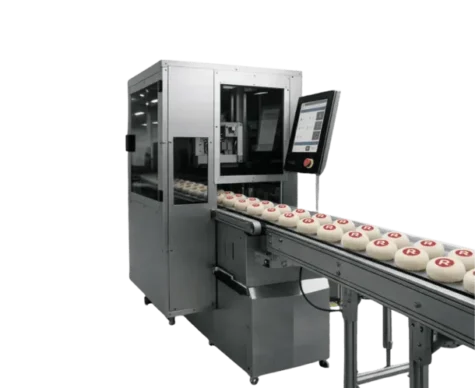
- Print system physically built into the production line, often integrated with a digital or offset press
- Product moves on a conveyor at constant speed (line takt)
- A stationary head bar applies the full print in a single pass
- Speed: up to 0.5 m/s (30 m/min)
Ideal for:
- Mass or serial production (High Volume)
- Constant line takt (bottle filling, capping line)
- Limited SKU variability (Low to Medium Mix)
- Maximum automation requirements
Benefits:
- Extremely high throughput (up to 10,000+ units/hour depending on print field)
- Predictable takt – print synchronized with the line
- Minimal internal transport – one continuous flow
- MES integration – automatic order pulling, real-time reporting
Challenges:
- Higher CAPEX (systems designed to order, tailor-made)
- Mechanical and system integration complexity
- Less flexibility for radical product changes
Sample applications:
- Cap and closure production lines
- Appliance/electronics front decoration on assembly lines
- Pharmaceutical packaging marking
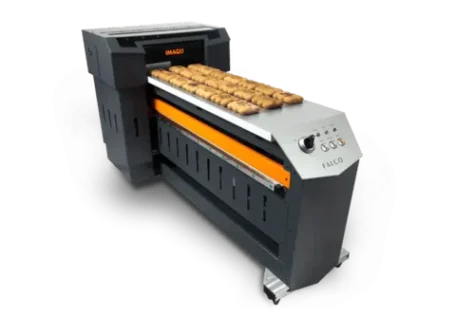
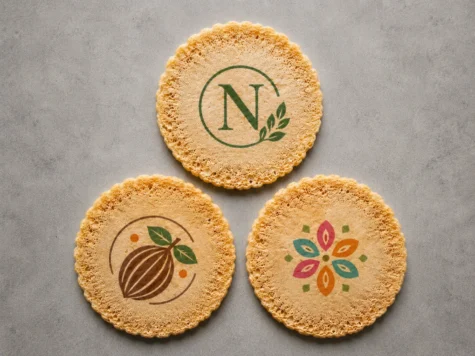
- Food product decoration (packaging, direct-on-product)
B) Standalone print stations (Near-line)
Characteristics:
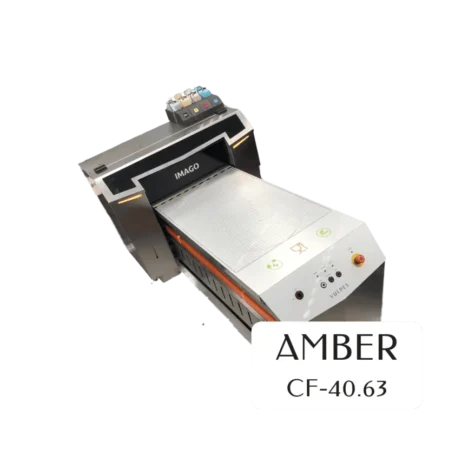
- Standard or modified flatbed printers or digital presses
- Operating as independent production cells near the main line
- Operator or robot loads/unloads products
- Scanning print (head moves over the product)
Ideal for:
- High-Mix / Low-Volume production
- Non-standard product geometries and sizes
- Short runs, prototyping
- Flexible changeovers
Benefits:
- Lower CAPEX – standard machines and presses available on the market
- Maximum flexibility – handles diverse products
- Low integration complexity – operates quasi-independently
- Quick changeovers – design changes in minutes
- Multi-substrate capability – digital print runs on films, textiles, canvas materials and many others, expanding production possibilities
Optimization through automation:
- Collaborative robots (cobots): automatic loading/unloading, removing manual work
- AGV/AMR (autonomous mobile vehicles): batch transport between print station and warehouse/main line
Result: efficiency close to inline systems while keeping flexibility.
Sample applications:
- Premium product personalization (cosmetics, corporate gadgets)
- Industrial component marking (nameplates, panels)
- Short runs of seasonal products
- Proof-of-concept before full inline deployment
Communication With MES/ERP Systems: The OPC UA Standard
A digital industrial printer isn’t an isolated machine. It’s an intelligent node in the factory’s Cyber-Physical System (CPS). Integration with higher-level systems is fundamental to realizing the Industry 4.0 vision.
Integration architecture:
Level 1: MES (Manufacturing Execution System) connection
- Production order pulling: automatic import of graphics, print parameters, copy counts
- VDP data pulling: for serialization and personalization, connecting to MES databases or directly to ERP
- Real-time reporting:
- Machine status (running, stopped, error, changeover)
- Production count (good/rejects)
- Material consumption (ink, primer)
- Alarm and error logs
Result: automatic OEE calculation, downtime root cause analysis, predictive maintenance.
Level 2: ERP (Enterprise Resource Planning) integration
- Material reservation (ink, substrates)
- Real-time inventory updates
- Production cost calculation per order
- Consumables delivery planning
Communication standard: OPC UA (Open Platform Communications Unified Architecture)
What is OPC UA?
- Open Machine-to-Machine (M2M) communication standard for industrial automation
- Platform-independent (Windows, Linux, embedded systems)
- Secure (encryption, authentication, authorization)
- Semantic data model (not just value exchange, but context as well)
Why does OPC UA matter?
- Interoperability: machines from different manufacturers communicate without dedicated gateways
- Data standardization: a unified “data backbone” across the factory
- Future-proofing: ready for advanced AI/ML applications (Big Data analysis from production lines)
Practical implementation: Not every digital printer offers native OPC UA support out of the box, but:
- Industrial manufacturers (like IMAGO Printer in Single Pass systems) often implement an OPC UA Server in the machine controller
- For machines without native support: dedicated OPC UA Gateways translate proprietary protocols (Modbus, Ethernet/IP) into OPC UA
Recommendation: when buying an industrial digital printer, OPC UA capability should be a selection criterion for any company planning full Industry 4.0 integration.
Predictive Maintenance and Minimizing Unplanned Downtime
A central benefit of digital integration is moving from reactive maintenance (fix after failure) to predictive maintenance (prevent failure).
How it works:
- Telemetry data collection: the printer reports parameters to MES/IoT, including:
- Head firing count (life counter)
- Head and UV lamp temperature
- Ink system pressure
- Material consumption levels
- Alarm frequency and type
- ML algorithm analysis: machine learning identifies patterns preceding failures (rising head temperature before damage)
- Prediction and alerting: the system generates alerts to the maintenance team in advance (“head #3 needs servicing within 48h”)
- Planned intervention: maintenance happens during planned stops (end of shift, weekend), not during production
Access to technical support is crucial for minimizing downtime and optimizing digital printing system performance, as expert assistance with installation, troubleshooting, and process optimization ensures smooth operation.
Benefits:
- 30-50% reduction in unplanned downtime
- Extended component life through optimal service timing
- Spare parts inventory optimization – just-in-time ordering based on prediction
- Lower service costs – planned interventions cost less than line failures
For manufacturers offering advanced digital systems, predictive maintenance is becoming standard. Remote monitoring by the supplier shortens service response times further.
Strategic Benefits and Building Competitive Advantage
From Cost Optimization to Business Model Transformation
Digital print implementation isn’t just operational cost reduction. It’s a fundamental shift in business model toward greater flexibility and customer focus.
Traditional model (Push – make-to-stock):
- Producing large runs of one variant to lower unit cost
- Warehousing finished products
- Risk: overproduction, obsolescence, demand unpredictability
- Long lead time for market response
Digital print model (Pull – make-to-order):
- Production on demand (Make-to-Order, Mass Customization)
- Minimal inventory – products created only after order confirmation
- Flexibility: every unit can be different (personalization) without cost increase
- Short lead time – fast response to trends
- Print personalization and digital output enable flexible market response. Digital print delivers personalized materials, building closer customer relationships.
Transformation example: a premium cosmetics manufacturer moved from a model of 10,000 units across each of 20 variants (200,000 units in stock, 2 million PLN value) to a digital print model with 500 units per variant + on-demand reprint (10,000 units in stock, 100,000 PLN value).
Result:
- Frozen capital reduction of 1.9 million PLN
- Eliminated obsolescence risk (cosmetics have short shelf-life)
- Ability to test 50+ variants without risk instead of 20 proven ones
- Margin growth from offering limited editions and personalization
Sustainability as a Competitive Edge
With growing consumer environmental awareness and tightening regulations, sustainability has become a market differentiator. Digital print is becoming more accessible, more precise and more eco-friendly, which appeals to publishers and manufacturers alike.
Digital print as the more sustainable technology:
Digital output keeps high quality over long periods, which reduces the need for reprinting and cuts waste. Digital print generates less waste and uses fewer chemicals than traditional methods.
A) Eliminating analog waste
- No silicone backing on labels (eliminating 40-60% of label waste mass)
- No VOC emissions from solvent inks (pad printing)
- Print “without excess” – only where needed, zero ink waste
B) Lower energy consumption
- UV-LED lamps: 40-60% less energy than traditional mercury UV
- No drying process (unlike pad printing requiring drying ovens)
- Standby mode: fast transition to operation, low consumption when waiting
C) Reduced logistics carbon footprint
- No transport of labels from external print shops
- Less packaging (labels need protective packaging)
- Local “on-site” production instead of central label production and distribution
D) Longevity and upgrades instead of replacement
- Modern digital systems (like the IMAGO Printer platform) are designed with modularity in mind
- Upgrade options: adding colors, UV lamps, new software functions
- 7-10 year amortization instead of the typical 5 years for pad printing systems
Marketing communication: companies implementing digital print can leverage this as part of ESG (Environmental, Social, Governance) strategy and marketing:
- Sustainability certifications and reports
- On-pack messaging: “Printed using contactless technology, zero waste”
- Appeals to conscious consumers (especially effective in premium segments)
Real numbers:
- 25-40% CO2 emission reduction compared to labeling (LCA – Life Cycle Assessment studies)
- 10-30 tons of silicone waste eliminated annually for an average production facility
- EU directive compliance
Building Topical Authority and Expert Position
For B2B companies, implementing advanced digital technology also builds an innovator and industry leader image. Companies with experience supporting screen printers can leverage their expertise and customer support to help screen printing professionals transition smoothly to digital printing. One of the central elements of an effective strategy is implementing modern digital print technology.
How to use it:
- Case studies and white papers: publishing real implementation data (ROI, cost reduction, OEE growth) as expert content
- Trade fair participation: live Single Pass system demos as a demonstration of technology competence
- Technology supplier partnerships: collaboration with manufacturers (like IMAGO Printer) on pilot projects, getting early access to innovation
- Certifications and awards: applying for industry quality certifications (ISO 9001, ISO 14001) using the modern line as evidence
Effect:
- Talent attraction: young engineers and specialists want to work with modern technology
- B2B customer trust: perception as a serious partner, not an outdated supplier
- Premium pricing: justification for higher prices through innovation and process quality
Implementation Guide: From Decision to Production
Phase 1: Feasibility and ROI Analysis (4-6 weeks)
Step 1: Mapping current processes
- Inventory of all marking/decoration operations in the facility
- Cost identification: materials, labor costs, downtime, warehousing, waste
- KPI measurement: line OEE, average changeover time, scrap %, SKU lead time
- Understanding pain points across teams (production, maintenance, quality, logistics)
Step 2: Defining requirements and priorities
- Which materials will be printed? (specific substrate list with thicknesses, including paper types like coated or offset paper)
- What product geometries? (flat, cylindrical, complex 3D)
- Required throughput? (line takt, units/hour)
- Quality requirements? (resolution, durability, adhesion tests)
- Personalization/VDP need? (serialization, versioning)
- Integration with existing systems? (MES/ERP, interfaces)
Step 3: Vendor and technology model selection
- Inline (Single Pass) vs. Near-line (Flatbed) – matching the production profile
- Vendors with documented industry experience (IMAGO Printer for industrial applications)
- Local service availability and spare parts (SLA)
- Upgrade and system development options (modular platform)
Step 4: Proof Lab – Material Testing
- Delivering real materials and products to the supplier’s lab (including different paper types as potential substrates)
- Running adhesion, durability and visual quality tests
- Developing process profiles (primer + ink + UV)
- Critical: tests must confirm required parameters before investment
Step 5: Business calculation
- 5-7 year TCO model (CAPEX + OPEX + hidden costs)
- Break-even point analysis
- Scenario modeling: pessimistic, realistic, optimistic
- GO/NO-GO decision based on hard data
Supporting tools:
- ROI calculators (often provided by manufacturers)
- TCO analysis templates
- Industry benchmarks
Phase 2: Design and Integration (8-16 weeks)
Step 1: Mechanical design and layout
- Designing machine position on the production floor
- Integration with existing conveyors/transport systems
- Designing tooling (jigs, fixtures) for non-standard geometries and various substrates, including metal, which may require special consideration in digital printing integration
- Ensuring service access and operator ergonomics
Step 2: Control system integration
- MES/ERP connection (API, OPC UA)
- Data flow configuration (orders, VDP, reporting)
- Communication tests and fail-safe scenarios
Step 3: Supporting infrastructure
- Power supply (often dedicated 3-phase circuits required)
- Compressed air (for pneumatic systems, plasma/corona activation)
- Ventilation/extraction (though UV-LED has minimal requirements)
- Auxiliary module installation (activation, UV pinning, vision control)
Step 4: FAT (Factory Acceptance Test) at the supplier
- Customer team visit to the manufacturer’s facility
- Verification of machine compliance with specification
- Performance and quality tests on customer materials
- Initial training of the technical team
Step 5: Installation and commissioning (SAT – Site Acceptance Test)
- Delivery, unloading, machine positioning (often requiring crane/forklift)
- Connection of utilities and systems
- Final tests in real production conditions
- Final acceptance and handover to operations
Phase 3: Onboarding and Optimization (4-12 weeks)
Step 1: Personnel training (critical for success)
- Operators: daily operation, job changes, basic troubleshooting (2-3 days)
- Maintenance technicians: maintenance, parts replacement, advanced diagnostics (3-5 days)
- Quality control: measurement methods, adhesion tests, color calibration (1-2 days)
- IT/process engineers: MES integration, VDP data management (2-3 days)
Step 2: Procedures and documentation
- SOPs (Standard Operating Procedures) for each role
- Control checklists (pre-start, post-shift)
- Preventive maintenance plans
- Alarm response procedures
Step 3: Pilot phase (ramp-up)
- Start with one low-risk product/SKU
- Gradual increase in volume and variant count
- KPI monitoring: OEE, first-pass yield, changeover time
- Bottleneck identification and elimination
Step 4: Continuous optimization
- MES data analysis – identifying improvement areas
- Building a material profile library
- Implementing best practices from other operators/shifts
- Regular performance reviews with the supplier (quarterly business reviews)
Typical timeline for full implementation: 4-9 months from decision to full production
FAQ: Common Questions About Digital Print Implementation
Is digital print more durable than pad printing?
Print durability depends on the combination of technology, material and process. With proper surface preparation (plasma/corona activation) and the right UV ink, digital print achieves adhesion and resistance comparable to or better than pad printing. Digital print quality matches or exceeds traditional techniques, which means high marking durability. Proof Lab testing (cross-hatch test ASTM D3359, target: class 5B) confirms that modern UV-LED systems meet the most rigorous industrial standards. Digital print also doesn’t use VOC-emitting solvent inks, making it safer for the environment and workers.
What’s the realistic ROI period for digital print investment?
ROI depends on production profile, but typical ranges are:
- High-Mix/Low-Volume production: 18-30 months
- Mass production with personalization (VDP): 24-36 months
- Replacement of expensive label logistics: 12-24 months
Key ROI accelerators: number of monthly changeovers, label/cliché storage costs, leveraging personalization for premium pricing. Companies with more than 30 monthly SKU changes often see ROI under 2 years.
Does digital print need specialized operator training?
Modern digital print systems are designed with simplicity in mind (operator-first design). Basic operator training takes 2-3 days and covers: job loading, print start-up, material replacement, basic troubleshooting. The HMI (Human-Machine Interface) is intuitive, often with touchscreens and guided workflows. Advanced functions (profile creation, calibration) need additional training for maintenance technicians (3-5 days), but daily operation is simple and doesn’t require specialized printing qualifications.
What materials can be printed digitally?
Practically any material used in industry, as long as preparation is right:
- Plastics: PP, PE, ABS, PS, PMMA, PC, PVC, PA (with plasma/corona activation for polyolefins)
- Metals: aluminum (including anodized – nanosolvent technology), steel, stainless steel (with primer)
- Glass: regular and tempered (with primer or activation)
- Wood and laminates: raw, lacquered, HPL, MDF
- Composites and building materials: panels, boards
- Coated fabrics: for packaging applications
Digital print performs on diverse materials, which matters in promotional product manufacturing where durable, attractive prints on varied surfaces are essential.
The material list is practically unlimited. The Proof Lab process at the supplier is the key, where adhesion and durability are tested on the customer’s specific substrates before investment.
How does digital print integrate with existing production lines?
Integration can take two paths:
- Inline (Single Pass): print system built directly into the line, MES/ERP communication via OPC UA or other industrial protocols. Requires tailor-made design by the supplier, who adapts track width, takt and interfaces to existing infrastructure. Typical integration time: 3-6 months.
- Near-line (Standalone): autonomous print station operated manually or by robots. Needs minimal integration – usually network file delivery (or USB) is enough. Optionally reports to MES. Implementation time: 1-2 months.
Critical: experienced suppliers (like IMAGO Printer) offer end-to-end integration services, from mechanical design to IT system communication setup, minimizing the risk of problems.
Can digital print replace screen printing in my facility?
Digital print works well as a screen printing replacement in these scenarios:
- Short and medium runs (up to a few thousand units)
- Production with high design variability (High-Mix)
- Personalization or variable data printing needs
- Required fast time-to-market (no matrices = no delays)
- Complex graphics, gradients, photorealism
Traditional methods like screen printing or offset are increasingly giving way to modern digital technology in many applications, especially where flexibility, speed and lower setup costs matter. Digital print is the right fit for small and medium runs because it eliminates the high upfront costs of matrix creation.
Screen printing stays competitive for:
- Mass production (tens/hundreds of thousands of uniform units)
- Extreme mechanical durability (workwear)
- Special effects unavailable in digital print (highly conductive paints, for example)
In practice, many facilities adopt a hybrid model: digital print for flexibility and short runs, screen printing for mass production. The trend is clear though – digital print is taking growing market share thanks to falling costs and rising performance.
Summary: Digital Print as a Strategic Necessity, Not an Option
Economic, operational and strategic analysis shows clearly that implementing industrial digital print to replace labeling or pad printing isn’t just a technology upgrade. It’s a fundamental transformation of competitive capability.
Three benefit dimensions:
1. Economics: Lower TCO and predictable costs
- Eliminating preparation costs (clichés, labels, MOQs)
- Downtime reduction of 50-70% through changeovers in minutes instead of hours
- Storage savings: 40-70% less frozen capital
- Typical ROI: 18-36 months, with options to shorten to 12 months in High-Mix environments
2. Operations: Flexibility and response speed
- Variable Data Printing (VDP) without “technology penalties” – serialization, personalization, versioning
- Time-to-market reduction of 50-70% – from weeks to days
- Just-in-Time production eliminating obsolescence risk
- Industry 4.0 integration: predictive maintenance, real-time OEE, full traceability
3. Strategy: Competitive advantage and new business models
- Mass personalization capability (15-30% premium pricing)
- Building an innovator and ESG leader image (25-40% CO2 reduction)
- Opening new market segments requiring compliance (pharmaceuticals, electronics)
- Strategic flexibility – ability to pivot products without rebuilding infrastructure
Where digital print is must-have:
- Companies with High-Mix/Low-Volume production (>20 SKUs monthly)
- Manufacturers requiring regulatory compliance (serialization, traceability)
- Premium brands focused on personalization and limited editions
- Facilities pursuing Lean Manufacturing and OEE maximization
- Organizations with ambitious ESG and sustainability goals
Where digital print needs deeper analysis:
- Mass production Low-Mix (1-5 SKUs, volumes >100,000 units/month of one variant). Even here, if versioning or personalization is on the roadmap, digital print gains the edge.
Critical success steps:
- Solid TCO analysis covering hidden costs (not just machine price)
- Material testing at Proof Lab before investment – guaranteeing repeatability
- Choosing an experienced supplier with documented industrial portfolio (like IMAGO Printer)
- Comprehensive personnel training – the technology is simple, but it requires a mindset change
- Continuous optimization and using MES data to build a best-practices library
Final takeaway: in the Industry 4.0 era, where flexibility, personalization and response speed determine market success, digital print stops being “nice-to-have” and becomes a strategic necessity. Digital print delivers high quality across the most demanding industries with broad applications. Companies implementing it today gain a 2-3 year edge over competitors still running analog methods. In a fast-moving business environment, that edge can decide whether you lead or follow.
The question isn’t whether to implement digital print. It’s how fast you can do it without losing market momentum.